 |
MEASUR-Tools-Suite v1.2.4
The MEASUR Tools Suite is a collection of industrial efficiency calculations written in C++ and with bindings for compilation to WebAssembly.
|
|
MEASUR-Tools-Suite v1.2.4
The MEASUR Tools Suite is a collection of industrial efficiency calculations written in C++ and with bindings for compilation to WebAssembly.
|
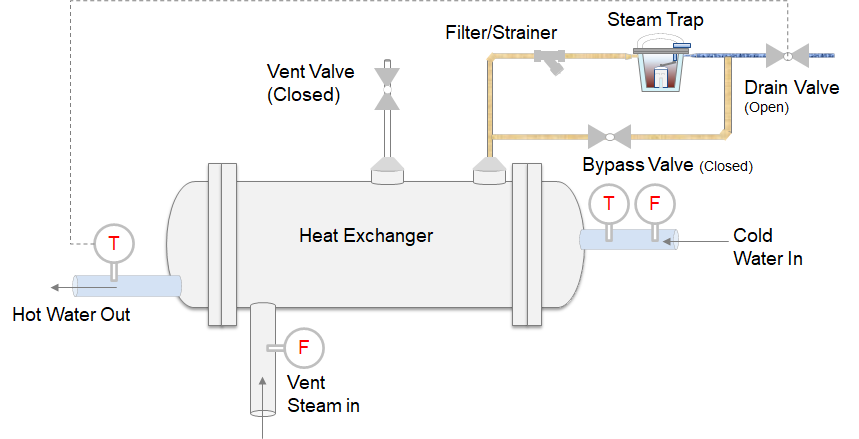
This calculator estimates the benefit of using vent steam for water heating applications. The calculation uses steam and water properties, flow rates, pressures, temperatures, and system efficiencies. The method is based on standard industrial practice for waste heat recovery in steam systems.
*
The calculation follows a top-down approach:
Relevant formulas and symbol definitions are documented below.
Outlet water temperature based on energy balance between steam and water.
The outlet water temperature is calculated by adding the temperature rise to the inlet water temperature. The temperature rise is determined by the energy transferred from the condensing steam (enthalpy difference) divided by the heat capacity of the water. Water specific heat is physics::si::kSpecificHeatWater (4.1796 kJ/(kg·K)).
\begin{equation}\label{eq:water-heating-steam-outlet-temp} T_{w,out} = T_{w,in} + \frac{(h_{s,in} - h_{s,out}) \cdot \dot{m}_{steam}}{C_{p,w} \cdot 1000 \cdot \dot{V}_{water}}\end{equation}
| \(T_{w,out}\) | Outlet water temperature \([\unit{ \kelvin}]\) |
| \(T_{w,in}\) | Inlet water temperature \([\unit{ \kelvin}]\) |
| \(h_{s,in}\) | Inlet steam specific enthalpy (saturated vapor) \([\unit{ \kilo\joule\per\kilogram}]\) |
| \(h_{s,out}\) | Outlet steam specific enthalpy (saturated liquid/condensate) \([\unit{ \kilo\joule\per\kilogram}]\) |
| \(\dot{m}_{steam}\) | Steam mass flow rate \([\unit{ \kilogram\per\hour}]\) |
| \(C_{p,w}\) | Water specific heat - see physics::si::kSpecificHeatWater \([\unit{ \kilo\joule\per\kilogram\kelvin}]\) |
| \(\dot{V}_{water}\) | Water volumetric flow rate \([\unit{ \meter\cubed\per\hour}]\) |
Safe operating temperature threshold to prevent boiling.
The safe boiling point temperature is calculated as 96.328% of the saturation temperature at the outlet water pressure. This safety margin prevents the outlet water from reaching the boiling point, which could cause operational issues in the heat exchanger. The saturation temperature is determined from steam tables based on the outlet water pressure.
\begin{equation}\label{eq:water-heating-steam-safe-boiling-point} T_{bp,safe} = 0.96328 \cdot T_{sat}(P_{w,out})\end{equation}
| \(T_{bp,safe}\) | Safe boiling point temperature \([\unit{ \kelvin}]\) |
| \(T_{sat}\) | Saturation temperature at outlet pressure \([\unit{ \kelvin}]\) |
| \(P_{w,out}\) | Outlet water pressure \([\unit{ \mega\pascal\abs}]\) |
Rate of heat transfer from steam to water (normal operation).
The heat gain rate is calculated as the product of the steam mass flow rate and the enthalpy difference between inlet steam (saturated vapor) and outlet condensate (saturated liquid). This represents the latent heat of condensation transferred to the water. This formula is used when the outlet water temperature is below the safe boiling point.
\begin{equation}\label{eq:water-heating-steam-heat-gain-rate} \dot{Q}_{gain} = (h_{s,in} - h_{s,out}) \cdot \dot{m}_{steam}\end{equation}
| \(\dot{Q}_{gain}\) | Heat gain rate \([\unit{ \kilo\joule\per\hour}]\) |
| \(h_{s,in}\) | Inlet steam specific enthalpy (saturated vapor) \([\unit{ \kilo\joule\per\kilogram}]\) |
| \(h_{s,out}\) | Outlet steam specific enthalpy (saturated liquid/condensate) \([\unit{ \kilo\joule\per\kilogram}]\) |
| \(\dot{m}_{steam}\) | Steam mass flow rate \([\unit{ \kilogram\per\hour}]\) |
Rate of heat transfer when boiling point is exceeded.
If the calculated outlet water temperature exceeds the safe boiling point, the heat gain rate is recalculated based on the temperature rise limited to the safe boiling point. The adjusted heat gain rate uses the water heat capacity, temperature difference, and volumetric flow rate. The factor of 1000 converts the water density from kg/m³ to proper units.
\begin{equation}\label{eq:water-heating-steam-adjusted-heat-gain-rate} \dot{Q}_{gain,adj} = 1000 \cdot C_{p,w} \cdot (T_{bp,safe} - T_{w,in}) \cdot \dot{V}_{water}\end{equation}
| \(\dot{Q}_{gain,adj}\) | Adjusted heat gain rate \([\unit{ \kilo\joule\per\hour}]\) |
| \(C_{p,w}\) | Water specific heat - see physics::si::kSpecificHeatWater \([\unit{ \kilo\joule\per\kilogram\kelvin}]\) |
| \(T_{bp,safe}\) | Safe boiling point temperature \([\unit{ \kelvin}]\) |
| \(T_{w,in}\) | Inlet water temperature \([\unit{ \kelvin}]\) |
| \(\dot{V}_{water}\) | Water volumetric flow rate \([\unit{ \meter\cubed\per\hour}]\) |
Excess steam flow that must be bypassed to prevent boiling.
When the outlet water temperature would exceed the safe boiling point, some steam must be bypassed around the heat exchanger to limit the heat transfer. The bypass steam flow is calculated as the difference between the total steam flow and the steam flow required to achieve the safe boiling point temperature. This is only calculated when the boiling point warning flag is triggered.
\begin{equation}\label{eq:water-heating-steam-bypass-steam-flow} \dot{m}_{bypass} = \dot{m}_{steam} - \frac{\dot{Q}_{gain,adj}}{h_{s,in} - h_{s,out}}\end{equation}
| \(\dot{m}_{bypass}\) | Bypass steam flow \([\unit{ \kilogram\per\hour}]\) |
| \(\dot{m}_{steam}\) | Total steam mass flow rate \([\unit{ \kilogram\per\hour}]\) |
| \(\dot{Q}_{gain,adj}\) | Adjusted heat gain rate \([\unit{ \kilo\joule\per\hour}]\) |
| \(h_{s,in}\) | Inlet steam specific enthalpy (saturated vapor) \([\unit{ \kilo\joule\per\kilogram}]\) |
| \(h_{s,out}\) | Outlet steam specific enthalpy (saturated liquid/condensate) \([\unit{ \kilo\joule\per\kilogram}]\) |
Annual energy savings in the domestic water heating system.
The energy saved in the domestic water heater (DWH) is calculated by multiplying the heat gain rate by the annual operating hours and dividing by the water heater efficiency. The division by efficiency accounts for the fuel energy that would have been required to provide the same amount of useful heat. This represents the primary energy savings from using waste steam instead of conventional water heating.
\begin{equation}\label{eq:water-heating-steam-energy-saved-dwh} E_{saved,DWH} = \frac{\dot{Q}_{gain} \cdot t_{op}}{\eta_{heater}}\end{equation}
| \(E_{saved,DWH}\) | Annual energy saved in domestic water heater \([\unit{ \kilo\joule\per\year}]\) |
| \(\dot{Q}_{gain}\) | Heat gain rate \([\unit{ \kilo\joule\per\hour}]\) |
| \(t_{op}\) | Operating hours per year \([\unit{ \hour\per\year}]\) |
| \(\eta_{heater}\) | Water heater efficiency (fraction) \([\unit{ \unitless}]\) |
Annual energy savings in the boiler from condensate return.
The energy saved in the boiler is calculated from the condensate returned to the boiler system. By returning hot condensate instead of using cold makeup water, less energy is needed to generate steam. The calculation multiplies the net steam flow (excluding bypass), the enthalpy difference between condensate and makeup water, and the operating hours, then divides by the boiler efficiency. The net steam flow accounts for the usable condensate that can be returned to the boiler.
\begin{equation}\label{eq:water-heating-steam-energy-saved-boiler} E_{saved,boiler} = \frac{(\dot{m}_{steam} - \dot{m}_{bypass}) \cdot (h_{s,out} - h_{makeup}) \cdot t_{op}}{\eta_{boiler}}\end{equation}
| \(E_{saved,boiler}\) | Annual energy saved in boiler \([\unit{ \kilo\joule\per\year}]\) |
| \(\dot{m}_{steam}\) | Steam mass flow rate \([\unit{ \kilogram\per\hour}]\) |
| \(\dot{m}_{bypass}\) | Bypass steam flow \([\unit{ \kilogram\per\hour}]\) |
| \(h_{s,out}\) | Outlet steam specific enthalpy (saturated liquid/condensate) \([\unit{ \kilo\joule\per\kilogram}]\) |
| \(h_{makeup}\) | Makeup water specific enthalpy \([\unit{ \kilo\joule\per\kilogram}]\) |
| \(t_{op}\) | Operating hours per year \([\unit{ \hour\per\year}]\) |
| \(\eta_{boiler}\) | Boiler efficiency (fraction) \([\unit{ \unitless}]\) |
Annual water savings from condensate return.
The water saved is calculated from the condensate that can be returned to the boiler instead of being discharged. This is the net steam flow (excluding bypass) converted to volumetric flow and multiplied by the operating hours. The division by 1000 converts the mass flow (kg/hr) to volumetric flow (m³/hr) assuming water density of 1000 kg/m³. Returning condensate reduces the need for makeup water and provides both water conservation and energy savings benefits.
\begin{equation}\label{eq:water-heating-steam-water-saved} V_{saved} = \frac{(\dot{m}_{steam} - \dot{m}_{bypass}) \cdot t_{op}}{1000}\end{equation}
| \(V_{saved}\) | Annual water saved \([\unit{ \meter\cubed\per\year}]\) |
| \(\dot{m}_{steam}\) | Steam mass flow rate \([\unit{ \kilogram\per\hour}]\) |
| \(\dot{m}_{bypass}\) | Bypass steam flow \([\unit{ \kilogram\per\hour}]\) |
| \(t_{op}\) | Operating hours per year \([\unit{ \hour\per\year}]\) |
Modules | |
| Outlet Water Temperature Formula | |
| Outlet water temperature based on energy balance between steam and water. | |
| Safe Boiling Point Temperature Formula | |
| Safe operating temperature threshold to prevent boiling. | |
| Heat Gain Rate Formula | |
| Rate of heat transfer from steam to water (normal operation). | |
| Adjusted Heat Gain Rate Formula | |
| Rate of heat transfer when boiling point is exceeded. | |
| Bypass Steam Flow Formula | |
| Excess steam flow that must be bypassed to prevent boiling. | |
| Energy Saved in Domestic Water Heater Formula | |
| Annual energy savings in the domestic water heating system. | |
| Energy Saved in Boiler Formula | |
| Annual energy savings in the boiler from condensate return. | |
| Water Saved Formula | |
| Annual water savings from condensate return. | |
Files | |
| file | water_heating_using_steam.h |
| Water heating using vent steam calculations for process heating systems. | |
Namespaces | |
| namespace | water_heating_using_steam |
| Water heating using vent steam calculations for process heating systems. | |
Classes | |
| struct | water_heating_using_steam::WaterHeatingUsingSteamResults |
| Results of the water heating using steam calculation. More... | |
Functions | |
| WaterHeatingUsingSteamResults | water_heating_using_steam::waterHeatingUsingSteam (double pressure_steam_in, double flow_steam_rate, double temperature_water_in, double pressure_water_out, double flow_water_rate, double temp_makeup_water, double pres_makeup_water, double eff_water_heater, double eff_boiler, double operating_hours) |
| Calculates energy savings from using vent steam to heat water using a steam to liquid heat exchanger. | |
| WaterHeatingUsingSteamResults water_heating_using_steam::waterHeatingUsingSteam | ( | double | pressure_steam_in, |
| double | flow_steam_rate, | ||
| double | temperature_water_in, | ||
| double | pressure_water_out, | ||
| double | flow_water_rate, | ||
| double | temp_makeup_water, | ||
| double | pres_makeup_water, | ||
| double | eff_water_heater, | ||
| double | eff_boiler, | ||
| double | operating_hours | ||
| ) |
Uses process parameters to estimate the benefit of using vent steam for water heating and boiler operation.
| [in] | pressure_steam_in | Inlet steam pressure \([\unit{MPaa}]\) |
| [in] | flow_steam_rate | Steam flow rate \([\unit{kg/hr}]\) |
| [in] | temperature_water_in | Inlet water temperature \([\unit{K}]\) |
| [in] | pressure_water_out | Outlet water pressure \([\unit{MPaa}]\) |
| [in] | flow_water_rate | Water flow rate \([\unit{m3/hr}]\) |
| [in] | temp_makeup_water | Makeup water temperature \([\unit{K}]\) |
| [in] | pres_makeup_water | Makeup water pressure \([\unit{MPaa}]\) |
| [in] | eff_water_heater | Water heater efficiency (fraction) |
| [in] | eff_boiler | Boiler efficiency (fraction) |
| [in] | operating_hours | Operating hours \([\unit{hr}]\) |
 1.9.8
1.9.8